
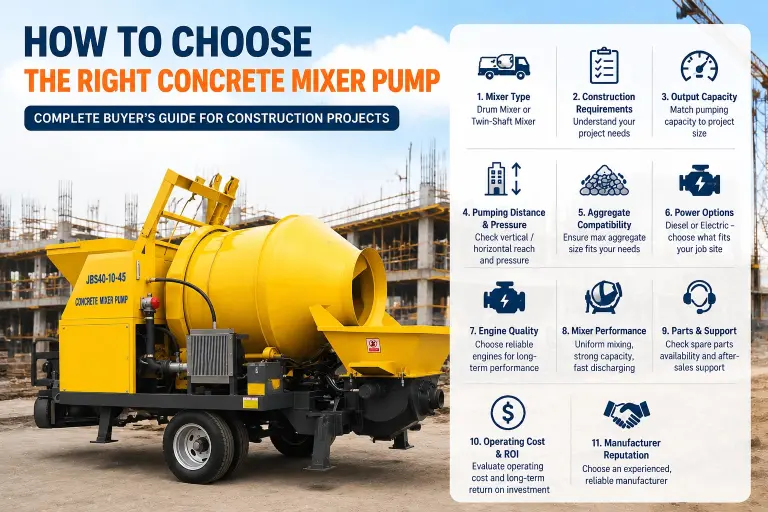
Introduction
Investing in a concrete mixer pump is one of the most important equipment decisions for contractors handling small to medium-scale construction projects. These versatile machines combine mixing and pumping into a single unit—saving space, reducing labor, and cutting costs compared to buying a separate mixer and pump. But with dozens of models, engine types, and specifications on the market, how do you pick the right one?
This guide breaks down everything you need to know to make a confident, informed purchase.
What Is a Concrete Mixer Pump?
A concrete mixer pump is an integrated machine that mixes raw materials (cement, aggregate, water) into concrete and then pumps the finished mix through delivery pipes to the pour site. Unlike traditional setups that require a standalone mixer and a separate pump, this all-in-one solution is compact, mobile, and ideal for rural housing, residential buildings, and small commercial projects.
Step 1: Drum Mixer Pump vs. Twin-Shaft Mixer Pump
Concrete mixer pumps come with two primary mixing mechanisms. Choosing the right one depends on the strength and consistency of the concrete your project demands.
| Feature | Drum Concrete Mixer Pump | Twin-Shaft Concrete Mixer Pump |
| Mixing Action | Gravity-based rotating drum | Forced mechanical mixing paddles |
| Concrete Quality | Standard grade (C15 – C30) | High performance (C30 and above) |
| Max Aggregate Size | Smaller aggregates (typically ≤ 30–40mm) | Handles coarse/heavy aggregates well |
| Best Used For | Rural housing, driveways, small foundations | Commercial floors, bridges, load-bearing structures |
| Maintenance | Simpler & lower initial cost | Higher upfront cost; paddles wear over time |
Key Rule: If you are running standard residential jobs, a drum mixer pump gives you the best return on investment (ROI). For strict engineering contracts requiring high-density, uniform concrete, upgrade to a twin-shaft forced mixer pump.
Step 2: Understand Your Construction Requirements
Before selecting a concrete mixer pump, the first step is to evaluate your actual construction needs.
Consider:
- What type of projects will you handle?
- How much concrete needs to be poured daily?
- What is the required pumping distance and height?
- What working conditions will the machine face?
Common applications include:
- Residential building construction
- Rural house construction
- Foundation pouring
- Road and bridge projects
- Tunnel and underground construction
- Commercial building projects
For small and medium projects, a compact concrete mixer pump is usually more practical due to its easy operation and mobility.
Step 3: Match Pumping Capacity to Your Project Size
Output capacity, measured in cubic meters per hour (m³/h), determines how much concrete you can place per hour. Choosing the wrong size leads to either bottlenecks or wasted investment.
| Model Class | Output Range | Typical Applications |
|---|---|---|
| Small mixer pumps | 15–30 m³/h | Rural housing, small slabs, minor repairs |
| Mid-size mixer pumps | 30–50 m³/h | Residential buildings (5–10 floors), small commercial projects |
| Large trailer pumps | 60–90 m³/h | Bridges, tunnels, high-rise buildings |
| Boom pump trucks | 85–200 m³/h | Large-scale infrastructure, high-rise commercial |
Pro tip: Calculate your average daily concrete requirement and choose a model that delivers 20–30% more than your peak demand. This buffer prevents delays during rush periods.
Step 4: Evaluate Pumping Distance and Pressure
Pumping distance (vertical and horizontal) and outlet pressure are critical specs that many buyers overlook. A pump with insufficient pressure cannot push concrete to upper floors or across long pipelines without blockages or segregation.
| Specification | What It Means | Typical Ranges |
|---|---|---|
| Vertical reach | How high the pump can deliver concrete | 40–300 m (mixer pumps: ~70–130 m; trailer pumps: up to 300 m) |
| Horizontal reach | How far across the site concrete can travel | 200–1,200 m |
| Outlet pressure | Force pushing concrete through pipes | 6–18 MPa (higher = better for tall buildings/long lines) |
For example, a JBS40 diesel mixer pump with 10 MPa pressure can typically handle 5- to 10-story residential buildings, while an HBT80 trailer pump at 16–18 MPa is built for high-rise and long-distance tunnel work.
Always verify real-world pumping data from the manufacturer rather than relying solely on theoretical maximums.
Step 5: Check Aggregate Compatibility
The maximum aggregate size your pump can handle must match the concrete mix you plan to use. Oversized aggregate is a leading cause of pipeline blockages and pump damage.
| Pump Type | Max Aggregate Size |
|---|---|
| Mixer pumps | Up to 40–50 mm (pebble/gravel) |
| Fine stone pumps | ≤30 mm |
| Large aggregate trailer/boom pumps | 40–50 mm |
Standard concrete mixes with 20–40 mm aggregate work well with most mixer pumps. If you plan to pump specialized mixes with larger stone, confirm the S-valve diameter and pipeline specs before buying.
Step 6: Choose Between Diesel and Electric Power
This choice depends almost entirely on your job site conditions and local infrastructure.
| Factor | Diesel Mixer Pump | Electric Mixer Pump |
|---|---|---|
| Best for | Remote areas, unstable power, mobile projects | Urban sites with stable 3-phase power |
| Advantages | Works anywhere; no grid dependency | Lower running cost; quieter; zero emissions |
| Key checks | Engine brand, fuel efficiency, parts availability | Voltage stability, motor power, cable safety |
| Typical power | 52–199 kW (Weichai, Yuchai, Cummins) | 37–110 kW |
Rule of thumb: If your site lacks reliable electricity or you move frequently between locations, go diesel. If you work in urban areas with stable power and noise restrictions, electric will save you money long-term.
Step 7: Engine Type and Reliability
The engine directly affects machine performance, fuel consumption, and maintenance costs.
Common engine options include:
- China diesel engines
- Yanmar engines
- Kubota engines
- Isuzu engines
For regions with limited maintenance services, choosing a reliable engine brand with available spare parts is important.
A durable engine ensures:
- Stable operation
- Lower downtime
- Longer service life
Step 8: Evaluate Mixer Performance
A concrete mixer pump combines mixing and pumping functions, so the mixing system is critical.
A good mixer should provide:
Uniform Mixing
Ensures consistent concrete quality and prevents material separation.
Strong Mixing Capacity
Suitable for different concrete materials, including:
- Normal concrete
- Mortar
- Fine aggregate concrete
Fast Discharging
Improves working efficiency and reduces waiting time.
Step 9: Spare Parts Availability and After-Sales Support
Buying a concrete mixer pump is a long-term investment.
Before purchasing, check:
- Are spare parts easily available?
- Does the supplier provide technical support?
- Is operation training included?
- How quickly can replacement parts be delivered?
A reliable manufacturer should provide:
- Wearing parts supply
- Operation manuals
- Video guidance
- Remote technical assistance
Step 10: Consider Operating Cost and Return on Investment
The cheapest machine is not always the best choice.
A quality concrete mixer pump can help reduce:
- Labor costs
- Concrete waste
- Construction time
- Maintenance expenses
When comparing models, consider:
| Factor | Importance |
|---|---|
| Purchase Price | Medium |
| Pump Performance | High |
| Fuel Consumption | High |
| Maintenance Cost | High |
| Spare Parts | High |
| Service Support | High |
A slightly higher initial investment may provide better long-term value.
Step 11: Choose a Reliable Concrete Mixer Pump Manufacturer
A professional manufacturer can provide customized solutions according to your market and project requirements.
When selecting a supplier, check:
- Manufacturing experience
- Export experience
- Customer cases
- Product quality control
- Warranty policy
Working with an experienced supplier reduces purchasing risks and ensures better machine performance.
Quick Buying Checklist
Before you finalize your purchase, run through this checklist:
| Check | Check Item |
|---|---|
| ☐ | PDrum Mixer Pump vs. Twin-Shaft Mixer Pump |
| ☐ | Understand Your Construction Requirements |
| ☐ | Match Pumping Capacity to Your Project Size |
| ☐ | Evaluate Pumping Distance and Pressure |
| ☐ | Check Aggregate Compatibility |
| ☐ | Choose Between Diesel and Electric Power |
| ☐ | Engine Type and Reliability |
| ☐ | Evaluate Mixer Performance |
| ☐ | Spare Parts Availability and After-Sales Support |
| ☐ | Consider Operating Cost and Return on Investment |
| ☐ | Choose a Reliable Concrete Mixer Pump Manufacturer |